
Geely Battleship 700: 1129 HP, Tri-Motor AWD and Thor EM-T Hybrid System
The global SUV market is moving quickly toward electrified powertrains, but buyers still expect the capability traditionally associated with large off-road vehicles. The 2027 Geely Battleship 700 is designed around that balance, combining a high-output plug-in hybrid system with a tri-motor all-wheel-drive (AWD) layout and an AI-assisted digital chassis.
For international dealers and vehicle importers, the interest goes beyond the headline figure of 1129 hp. The more useful question is how the Thor EM-T hybrid system, independent electric motors and chassis technology work together in a vehicle intended for both paved roads and demanding terrain.
Below, we take a closer look at the key technology behind the Battleship 700 and what its specifications may mean for international buyers.

Geely Battleship 700: Key Specifications
| Specification | Geely Battleship 700 |
| Powertrain | Plug-in Hybrid |
| Combined System Output | Up to 1129 hp / approx. 830 kW* |
| Drivetrain | Tri-Motor AWD |
| Engine Options | 1.5T / 2.0T* |
| 0–100 km/h | 3.95 seconds* |
| Maximum Wading Depth | 800 mm* |
| Rear Motor Layout | Dual P4 Independent Motors |
| Suspension Technology | CCD + Dual-Chamber Air Suspension* |
*Specifications may vary by configuration and market. Performance figures should be checked against the specification of the vehicle supplied for the relevant market.
What Makes the Geely Battleship 700 a High-Output Hybrid SUV?
Thor EM-T Hybrid Architecture
At the center of the Battleship 700 is Geely’s Thor EM-T hybrid architecture. Instead of treating electrification simply as a way to reduce fuel consumption in urban driving, the system combines an internal-combustion engine with electric motors to provide both efficiency and strong torque delivery.
This approach is particularly relevant for a large off-road SUV. Electric motors can provide torque quickly from low speed, while the combustion engine can support longer-distance driving and energy generation.
For buyers comparing hybrid SUVs, the important point is not only the peak power figure. The way the engine, battery and electric motors work together has a direct effect on acceleration, traction and overall driving behavior.
1129 HP Combined System Output
The Battleship 700 is stated to deliver up to 1129 horsepower, equivalent to approximately 830 kW of combined system output.
That is a substantial figure for a vehicle of this type. More importantly, the output is supported by an electrified drivetrain rather than relying entirely on a large conventional combustion engine.
For an off-road vehicle, high output can provide useful power reserves when climbing steep sections, carrying additional loads or dealing with low-grip surfaces. Actual performance, however, will still depend on vehicle configuration, battery state, road conditions and driving mode.
0–100 km/h in 3.95 Seconds
Despite its large SUV proportions and off-road-oriented design, the Battleship 700 is quoted with a 0–100 km/h acceleration time of 3.95 seconds.
The electric motors play an important role here. Unlike a conventional combustion-only drivetrain, electric motors can deliver substantial torque from very low speed, helping the vehicle respond quickly when the accelerator is pressed.
For everyday drivers, this means the vehicle is not limited to the slow, heavy feeling often associated with traditional large off-road SUVs.
How Does the Tri-Motor AWD System Work?
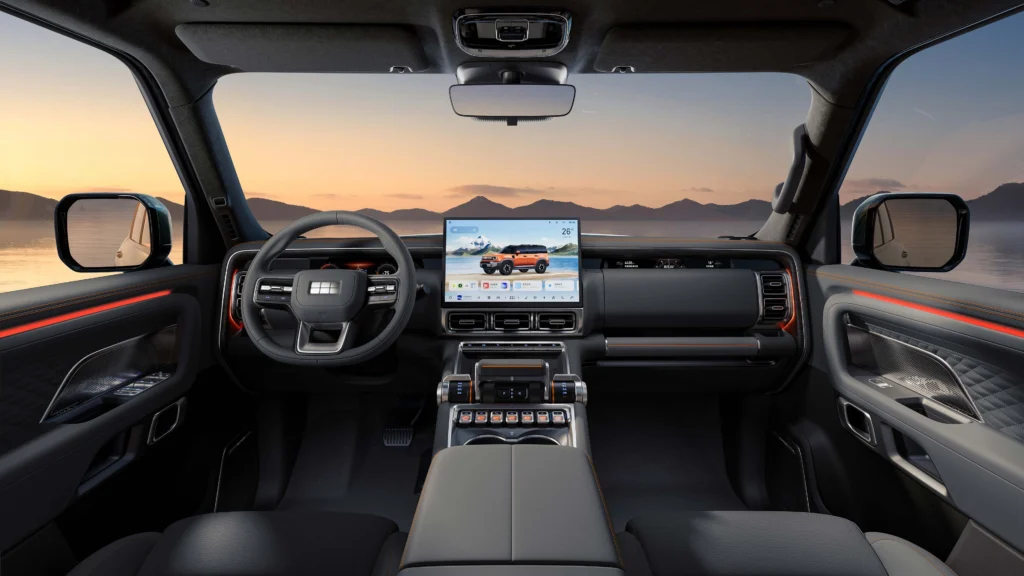
One of the more interesting technical features of the Battleship 700 is its tri-motor AWD configuration.
Dedicated Hybrid Engine Integration
The powertrain uses a dedicated hybrid internal-combustion engine, with 1.5T and 2.0T configurations referenced for the system.
The engine can contribute to propulsion while also supporting the vehicle’s energy management strategy. This gives the hybrid system more flexibility during longer trips, particularly when driving conditions make continuous electric-only operation less practical.
For international buyers, this type of architecture can be particularly relevant in markets where long-distance driving and charging infrastructure vary significantly between regions.
Dual P4 Rear Motors
The rear axle uses two independent P4 electric motors, working together with a front electric motor to create the tri-motor layout.
The advantage is not simply the number of motors. Independent rear-wheel control gives the drivetrain more flexibility in distributing torque according to available grip.
On loose surfaces such as mud, sand or snow, that additional control can help the vehicle manage wheel slip more precisely than a conventional mechanically linked AWD system.
Intelligent Torque Distribution
Off-road performance depends on more than horsepower.
The vehicle’s control system monitors factors such as wheel slip, steering input and driving conditions, then adjusts torque distribution between the axles and individual rear wheels.
This is particularly useful when the available grip changes from one wheel to another. Rather than sending the same amount of torque everywhere, the system can direct power toward wheels with better traction.
For buyers evaluating an advanced AWD vehicle, this is one of the more meaningful differences between a tri-motor setup and a conventional drivetrain.
AI Digital Chassis and Off-Road Technology
Power is only one part of the Battleship 700’s off-road package. The chassis technology is designed to help the vehicle make better use of that power.
Waltz Tank Turn Capability
One of the distinctive functions associated with the Battleship 700 is its “Waltz” tank-turn capability.
Using independent rear motors and the digital chassis system, the vehicle can perform a 360-degree turning maneuver within a very limited space.
This is not a feature most drivers will use every day, but it can have practical value in specific off-road situations. Narrow trails, dead ends and restricted spaces can make conventional turning difficult, and independent wheel control can reduce the space required for maneuvering.
800 mm Maximum Wading Depth
The Battleship 700 is stated to offer a maximum wading depth of 800 mm.
For an off-road SUV, water-crossing capability is an important specification, particularly in markets where seasonal flooding, river crossings or wet terrain are common.
The vehicle’s high-voltage electrical components are designed with water resistance in mind, with the original specification referring to IP68 protection for key electrical components.
As with any wading specification, the stated maximum should not be interpreted as permission to drive through water without considering speed, water flow, road conditions and the manufacturer’s operating limits.
Adaptive Air Suspension and CCD
The suspension system combines continuous damping control (CCD) with dual-chamber air suspension technology.
The idea is straightforward: the suspension can adapt its damping and ride height to different driving conditions rather than using one fixed setup for every situation.
On rough terrain, additional suspension travel and appropriate damping can help maintain wheel contact and reduce the impact transferred into the cabin. On paved roads, the system can prioritize ride comfort and body control.
This combination is particularly relevant for a vehicle expected to move between highway driving and off-road environments.
What Does the Battleship 700 Offer International Buyers?
For an international dealer, the vehicle’s value is not determined by horsepower alone. Running costs, durability, configuration, after-sales support and suitability for local driving conditions all matter.
Hybrid Efficiency for Everyday Driving
The Thor EM-T system is designed to combine electric propulsion with the combustion engine according to driving conditions.
At lower speeds, electric propulsion can reduce reliance on the combustion engine. During longer highway journeys or situations where sustained power is required, the engine can contribute more actively to the overall powertrain.
This type of hybrid strategy can offer a practical balance between electric driving and long-distance flexibility.
Actual fuel consumption will vary depending on driving conditions, temperature, vehicle load and driving mode, so quoted efficiency figures should always be considered alongside the relevant test standard.
Designed for Demanding Environments
The Battleship 700 is positioned as an SUV capable of handling a wide range of environments, from paved highways to demanding off-road terrain.
For international buyers, however, “off-road capable” should be evaluated in practical terms. Local climate, road quality, fuel availability, charging infrastructure, spare-parts supply and after-sales service can all influence whether a vehicle is suitable for a particular market.
These factors are often just as important as the vehicle’s peak performance figures when building a long-term product lineup.
Maintenance and Operating Considerations
The hybrid powertrain also changes the way energy and braking are managed.
Electric motors can provide a significant portion of the vehicle’s acceleration, while regenerative braking can recover energy during deceleration. This can reduce reliance on friction braking under suitable driving conditions.
That does not mean maintenance requirements disappear. A plug-in hybrid still combines high-voltage electrical components with a combustion engine, so service procedures, technician training and parts availability remain important considerations for overseas buyers.
How Does the Battleship 700 Compare with Conventional Luxury SUVs?

The Battleship 700 takes a different approach from traditional large luxury SUVs.
A conventional high-performance SUV may rely primarily on a large combustion engine and mechanical AWD system. The Battleship 700 instead combines a combustion engine with three electric motors and software-controlled torque distribution.
This architecture can provide several practical differences:
- Rapid electric torque delivery at low speed
- Independent control of the rear wheels
- More flexible torque distribution
- Regenerative braking
- Electrified propulsion during suitable driving conditions
- Greater control over low-speed off-road maneuvers
The result is not simply a higher horsepower number. It is a different way of combining performance, traction and electrification in a large SUV.
What Should International Buyers Check Before Ordering?
For dealers and importers, vehicle specifications are only the first step.
- Before placing an order, it is worth confirming:
- Exact powertrain and motor configuration
- Battery and charging specifications
- Left-hand-drive or right-hand-drive availability
- Local homologation and certification requirements
- Charging compatibility in the destination market
- Warranty terms
- Spare-parts availability
- After-sales technical support
- Export documentation
- Shipping and delivery arrangements
Configurations can differ between markets, so buyers should confirm the exact specification and equipment list before making a purchasing decision.
Final Thoughts
The Geely Battleship 700 is an interesting example of how Chinese automakers are combining plug-in hybrid technology with increasingly sophisticated off-road drivetrains.
Its headline figures are certainly impressive: up to 1129 hp, a tri-motor AWD system and a quoted 0–100 km/h time of 3.95 seconds. But the more useful story is the technology behind those numbers.
The Thor EM-T hybrid system, independent rear motors, torque distribution and AI-assisted chassis work together to give the vehicle a broader range of capabilities than a conventional combustion-powered SUV.
For international buyers, the next step is less about comparing headline numbers and more about checking the exact configuration, market availability, certification requirements and after-sales conditions for the destination country.
Interested in Sourcing the Geely Battleship 700?
If you are a dealer, importer or fleet buyer looking to add Chinese new-energy vehicles to your local market, CNEVExport can help you review available vehicle configurations, specifications, export pricing and shipping options.
Visit https://cnevexport.com/ to explore more Chinese electric and hybrid vehicles for international markets.
FAQ
How much horsepower does the Geely Battleship 700 have?
The Geely Battleship 700 is stated to offer up to 1129 hp, or approximately 830 kW, in its high-output configuration. The exact specification should be confirmed for the vehicle and market being purchased.
Is the Geely Battleship 700 a plug-in hybrid?
Yes. The Battleship 700 uses a plug-in hybrid powertrain combining a combustion engine with electric motors and a high-voltage battery system.
How does the Battleship 700 tri-motor AWD system work?
The system combines a front electric motor with two independent P4 motors on the rear axle. This layout allows the vehicle to control torque distribution more precisely between individual wheels.
How fast is the Geely Battleship 700?
The vehicle is quoted with a 0–100 km/h acceleration time of 3.95 seconds for the relevant high-performance configuration.
How deep can the Geely Battleship 700 wade?
The stated maximum wading depth is 800 mm. Drivers should always follow the manufacturer’s operating limits and consider water speed, terrain and environmental conditions before attempting a water crossing.