Why the 2027 3rd-Gen BYD Tang EV Is Shaping Up as a Top Contender for the Best Large 5-Seat Electric SUV
The 2027 BYD Tang EV (3rd-Gen Tang) marks a major shift in China’s electric SUV supply chain. Previously, Chinese automakers tried to make one 5-meter crossover please every buyer at once. However, that approach often forced awkward compromises in third-row legroom. Therefore, BYD now dedicates a full 5-meter body strictly to five passengers. Consequently, the 2027 BYD Tang EV stands out as a top large 5-seat electric SUV.
Moving Past the Spec-Sheet Wars: What Makes the Best Large 5-Seat EV for 2027?
Anyone who spends time tracking China’s NEV supply chain knows that the market has moved past simply bolting a bigger battery onto a mid-size crossover and calling it a flagship. Heading into the 2027 model year, the toughest product planning question for Chinese OEMs isn’t how to build a 5-meter SUV—it is how to stop a single model from trying to please everyone and ending up with compromises everywhere.
Splitting the Dynasty Flagship Mission: 5-Seat Tang vs. 7-Seat Datang
For years, the original BYD Tang carried the entire Dynasty SUV lineup on its shoulders. Specifically, it squeezed seven seats into a 4.9-meter footprint. Now, however, BYD divides this workload across two distinct models for 2027 showrooms.
Meanwhile, for dedicated 5-seat comfort, the 2027 BYD Tang EV serves as an 8-Series flagship SUV. Consequently, it focuses entirely on five-seat space and long-haul touring efficiency.
First, for full-size 7-seat duty, the 5.3-meter BYD Datang EV serves large multi-generational families. Moreover, it carries a China domestic MSRP of RMB 239,900–309,900.
Key Reveal Milestones & 2027 Export Timeline
Exterior Debut: First shown to the public at the Chengdu Auto Show with updated Dynasty flagship styling.
October 8 Interior & Spec Release: Lu Tian, General Manager of BYD Dynasty Network Sales Division, unveiled the official cabin images and core hardware specs ahead of the model’s Q4 domestic launch and 2027 model-year overseas export rollout.
Top Interior Upgrade: Why BYD Split the 2027 Tang Dashboard Into Two Layouts
The biggest surprise in the October 8 official cabin reveal isn’t just that BYD retired its long-standing rotating center pad—it is that BYD engineered two distinct dashboard tooling layouts for the same vehicle. From a supply chain and BOM management standpoint, offering two different upper-dash architectures on a single model line is unusual for BYD, showing how seriously they are taking buyer segmentation in China’s domestic RMB 220,000–260,000 (approx. $31,000–$36,500 USD domestic retail benchmark) bracket.
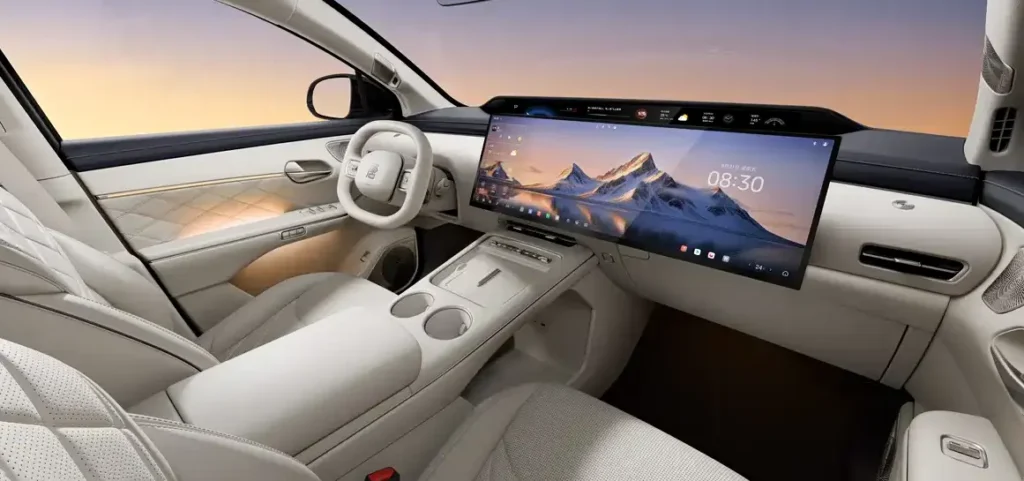
1. The “Dune Beige” Tech-Forward Layout
Interstellar Dual-Screen Architecture: Inspired by sci-fi spacecraft consoles, this trim pairs an unbroken 30-inch panoramic center-and-passenger display with a 35.4-inch integrated far-end horizon screen tucked along the base of the windshield.
No More Polarized-Sunglass HUD Washout: By replacing both the traditional instrument binnacle and the HUD with a physical 35.4-inch far-field display (showing speed, navigation, weather, clinometer, and gear status), it solves the common real-world issue of HUD glare and washout when wearing polarized sunglasses.
Unobstructed Driver Sightline: Pairs the horizon screen with a squared-off, two-spoke single-tone steering wheel that keeps the upper viewing angle completely clear.
2. The “Amber Brown” Executive Layout
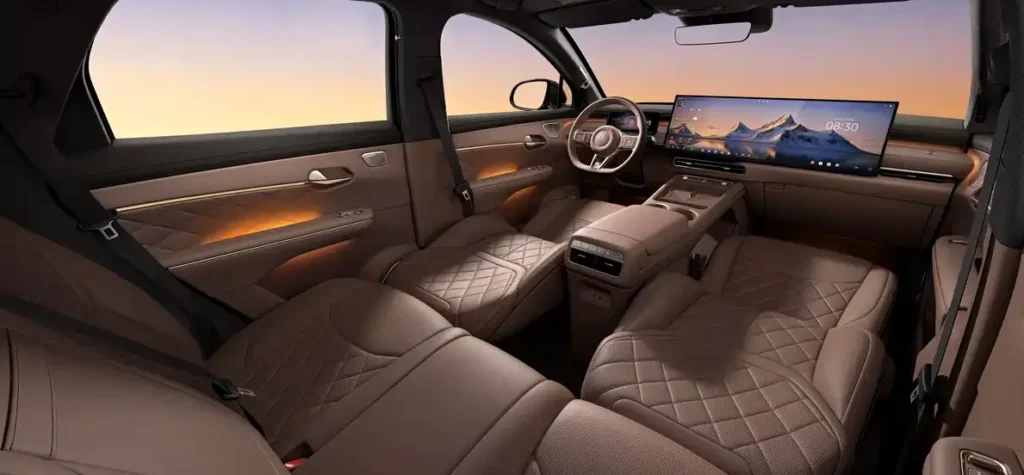
Classic Recessed Instrument Cluster: Designed for buyers who prefer a conventional driving interface, the Amber Brown cabin drops the far-end horizon strip in favor of an independent LCD instrument cluster alongside the 30-inch panoramic screen.
Datang-Derived Steering Wheel: Uses a rounder, three-spoke two-tone steering wheel borrowed from the flagship Datang series.
Physical Controls Retained: Both cabin variants keep physical shortcut buttons on the center console alongside dual wireless phone charging pads.
Material Finish: Both layouts feature diamond-quilted leather seating and wrap-around multi-color ambient lighting.
Best-in-Class Space Allocation: What Happens When a 5-Meter SUV Drops the Third Row
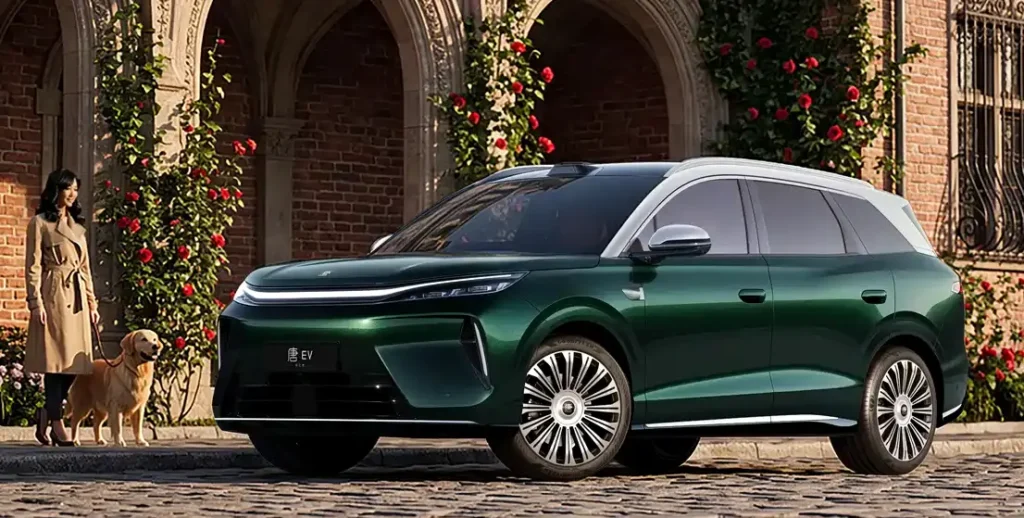
In previous generations, buyers often asked whether the third row in a mid-to-large SUV was actually usable for adults on a three-hour highway run. With the 2027 3rd-Gen Tang, BYD dedicates a full 5-meter footprint strictly to five passengers.
Exterior Footprint vs. Previous Generation
Full 5-Meter Proportions: Measures 5,045 mm in length, 1,980 mm in width, and 1,740/1,760 mm in height, riding on a 2,950 mm wheelbase with 1,700 mm front and rear tracks.
Generational Size Leap: Stretches 140 mm longer overall with 130 mm more wheelbase than the older Tang DM-i, matching the length and wheelbase of the BYD Tang L EV while channeling all interior volume into two rows.
Second-Row Comfort & Zero-Unloading Bed Mode
D-Segment Rear Legroom: Official data puts second-row legroom at over 1,000 mm, with rear seatbacks reclining up to 130 degrees—roughly 10 degrees further than a standard commercial airline business-class seat.
Zero-Unloading Front-Row Bed Mode: Instead of forcing campers to unpack their trunk to fold the second row flat, the front headrests can be removed and the front backrests reclined fully flat to bridge seamlessly with the rear seat cushions.
In-Car Cinema Experience: Occupants can stretch out against the rear backrests and watch the 30-inch front screen with Devialet audio without touching the cargo area.
How the 2027 3rd-Gen Tang Ranks Among BYD’s Top Flagship SUVs
To help fleet planners and market analysts see where this 2027 model-year contender sits relative to its showroom siblings, here is how the confirmed specifications and China domestic retail benchmarks stack up:
| Specification | 2027 3rd-Gen BYD Tang EV (8-Series) | BYD Tang L EV | BYD Datang EV (9-Series) |
| Market Positioning | Large 5-Seat Tech Flagship SUV | Mid-to-Large 7-Seat Family SUV | Full-Size D-Segment 7-Seat Flagship |
| Dimensions (L×W×H) | 5,045 × 1,980 × 1,740/1,760 mm | 5,040 × 1,996 × 1,760 mm | 5,302 × 1,999 × 1,810 mm |
| Wheelbase | 2,950 mm | 2,950 mm | 3,130 mm |
| Seating Layout | Dedicated 5-Seater (1,000mm+ 2nd-row legroom) | 2+3+2 (7-Seater) | 7-Seater / Executive 4-Seater |
| Cockpit Displays | 35.4″ Horizon Screen + 30″ Panoramic Screen (or Independent Cluster + 30″ Screen) | 15.6″ Rotating Center Screen + AR-HUD | Triple-Screen / Executive Rear Entertainment |
| Battery & CLTC Range | 88.682 kWh / 105.792 kWh; 730 / 830 / 850 km | 100.5 kWh; up to 670 km | 2nd-Gen Blade Battery; up to 800+ km |
| China Domestic MSRP* | Est. RMB 220,000–260,000 | RMB 229,800–289,800 | RMB 239,900–309,900 |
Note on China Domestic MSRP vs. B2B Export Pricing
Domestic Retail Benchmark Only: All price figures cited in this article reflect mainland China domestic guidance prices (MSRP) to illustrate model positioning.
Variables in B2B Export Quotes: Actual international FOB/CIF landed pricing depends on export licensing, inland transit, pre-shipment inspection, Ro-Ro or container ocean freight rates, and destination-country import duties.
Top Powertrain, 2nd-Gen Blade Battery & Chassis Hardware Highlights
Under the skin, the 2027 3rd-Gen Tang isn’t just a cabin refresh—it consolidates BYD’s latest high-voltage platform and chassis technology into a sub-260,000 RMB domestic price bracket.
1. High-Output Motor & All-Wheel-Drive Options
300 kW Single-Motor RWD Filing: Initial MIIT homologation filings list a rear-wheel-drive variant powered by the TZ205QYD permanent magnet synchronous motor delivering 300 kW (402 hp) and a calibrated top speed of 250 km/h.
Intelligent Dual-Motor AWD: Official briefings also confirm dual-motor intelligent all-wheel-drive configurations for buyers needing wet-weather stability and light-trail traction.
2. 850 km CLTC Range & 9-Minute Flash Charging
Two 2nd-Gen Blade Battery Capacities: According to the 33rd Batch of the NEV Purchase Tax Exemption Catalog, the vehicle offers 88.682 kWh and 105.792 kWh battery packs, rated for 730 km, 830 km, and 850 km under CLTC conditions.
All-Weather Flash-Charging Speed: BYD’s flash-charging architecture takes the battery from 10% to 97% SOC in just 9 minutes at ambient temperatures (5 minutes to reach 70%), adding only 3 extra minutes in extreme sub-zero environments.
3. DiSus-A Air Suspension & Standard God’s Eye B LiDAR
Flagship Chassis Hardware: Pairs a front double-wishbone and rear five-link independent suspension with DiSus-A dual-chamber air suspension and intelligent road-preview control.
Standard Roof-Mounted LiDAR: God’s Eye B assisted driving comes standard across the lineup, supporting urban NOA, highway pilot, and automated tight-spot parking.
Tracking 2027 Production & Top EV Hardware Benchmarks
Bringing 9-minute flash charging, DiSus-A air suspension, and standard LiDAR into China’s domestic 220,000-RMB bracket sets a new benchmark for overseas dealership groups and fleet planners mapping out their 2027 showroom lineups. Feel free to explore more CNEV insights on CNEV EXPORT or connect via our contact page to exchange notes.
FAQ
Q: When will the 3rd-Gen BYD Tang officially launch, and what is the expected price?
A: BYD has confirmed that the 3rd-Generation Tang will officially launch in China during Q4 2026, with industry estimates placing the main volume trims between RMB 220,000 and RMB 260,000.
Q: How does the 3rd-Gen Tang differ from the BYD Datang EV?
A: While the 3rd-Gen Tang adopts front-end styling cues from the Datang (including the integrated through-type LED light bar and sculpted side air intakes), they serve different segments. The Datang EV is a 5.3-meter, 7-seat D-segment flagship, whereas the 3rd-Gen Tang is a 5.04-meter, 5-seat SUV engineered for maximum second-row space and personal driving dynamics.
Q: Does every 3rd-Gen BYD Tang come with the 35.4-inch horizon screen?
A: No. The 35.4-inch far-end horizon screen is paired with the Dune Beige interior package, while the Amber Brown interior features a conventional independent instrument cluster alongside the 30-inch panoramic central display.